New Eco-friendly Lubricant Additives Protect Turbine Equipment, Waterways
New Eco-friendly Lubricant Additives Protect Turbine Equipment, Waterways
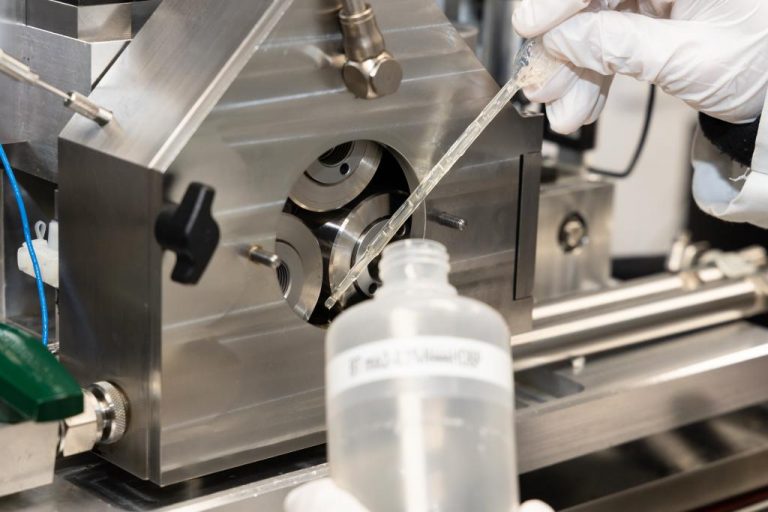
Scientists at the Department of Energy’s Oak Ridge National Laboratory have developed lubricant additives that protect both water turbine equipment and the surrounding environment.
Each year, roughly 2.47 billion gallons of lubricating oil are consumed in the United States alone for engines and industrial machinery, according to DOE, with about half eventually finding its way into the environment.
While environmentally acceptable lubricants are available, they are not optimized with additives that can greatly improve performance while posing minimal environmental impact if accidentally released. To create nontoxic, biodegradable and high-performing lubricant additives for water power turbines, researchers turned to ionic liquids, or ILs: organic liquid salts that mix well with oil, reduce friction between bearings and gears, and are stable in a range of temperatures.
A team of materials and environmental scientists at ORNL worked together to design, synthesize and test top-candidate ILs of ammonium phosphate and phosphonium phosphate that provide a good mix of properties.
When added to base oils, the ILs demonstrated 50% less friction and a tenfold decrease in equipment wear compared to a commercially available gear oil, while meeting federal standards for environmental toxicity and biodegradability, as described in ACS Sustainable Chemistry & Engineering
“Our previous work showed us that you could dramatically increase the performance of lubricants with the addition of just 1% or even a half-percent of ILs,” said ORNL’s Jun Qu, who leads the project and the Surface Engineering and Tribology group at ORNL.
This time around, scientists sought to create a nontoxic additive for use in turbines installed in aquatic environments, generating electricity using waves, tides, ocean and river currents. Although ILs are generally considered less toxic than conventional lubricant ingredients, their impact on the environment has not been closely studied.
“On the environmental side, there are three main factors we care about with these lubricants,” said Teresa Mathews, lead for the Biodiversity and Ecosystem Health group at ORNL. “They have to be highly performing, we don’t want them to be toxic to any aquatic organisms, and if there’s a spill, we don’t want the lubricants to be compounds that last in the environment. We want them to degrade very rapidly.”